

Introduction to AI SEO Workflow in 2026
AI has completely changed how SEO works in 2026, especially for beginners who don’t have big budgets, large teams, or years of experience. Instead of manually checking hundreds of keywords, reading dozens of competitor pages, and guessing what Google or AI search prefers, you can now plug your website into an AI SEO tool and get prioritized tasks within minutes. This is where an ai seo workflow for beginners 2026 becomes powerful: you follow the same simple steps every time, but AI does the heavy lifting in the background. You still make the final calls, but the data and suggestions are always ready for you.
At the heart of modern SEO is the shift from classic blue-link search results to AI overviews, answer engines, and chat-style responses inside Google and other platforms. That means your content is no longer just competing for a position on page one; it is also competing to be cited or paraphrased inside AI answers. For beginners, this sounds intimidating, but it is actually an opportunity because AI search cares less about domain age and more about topical authority, clarity, and complete answers. With a structured simple ai seo workflow for beginners 2026, you can cover topics in-depth, optimize for intent, and give AI exactly what it needs to trust and surface your pages.
New creators often worry that using AI will make their content feel robotic or generic, but that only happens when AI is used to generate entire articles without human editing. A human-centric workflow means using AI for what machines do best—pattern recognition, data processing, clustering—while you focus on story, personal experience, and opinion. This is where how to use ai for keyword research directly supports quality: AI helps you find opportunities and gaps, but you decide which topics match your brand and audience. When you consistently work with your AI tools through a repeatable SEO routine, each new article you publish is better aligned with search intent, AI search engines, and real readers.
Step 1: Clarify Your Niche, Audience, and Search Intent
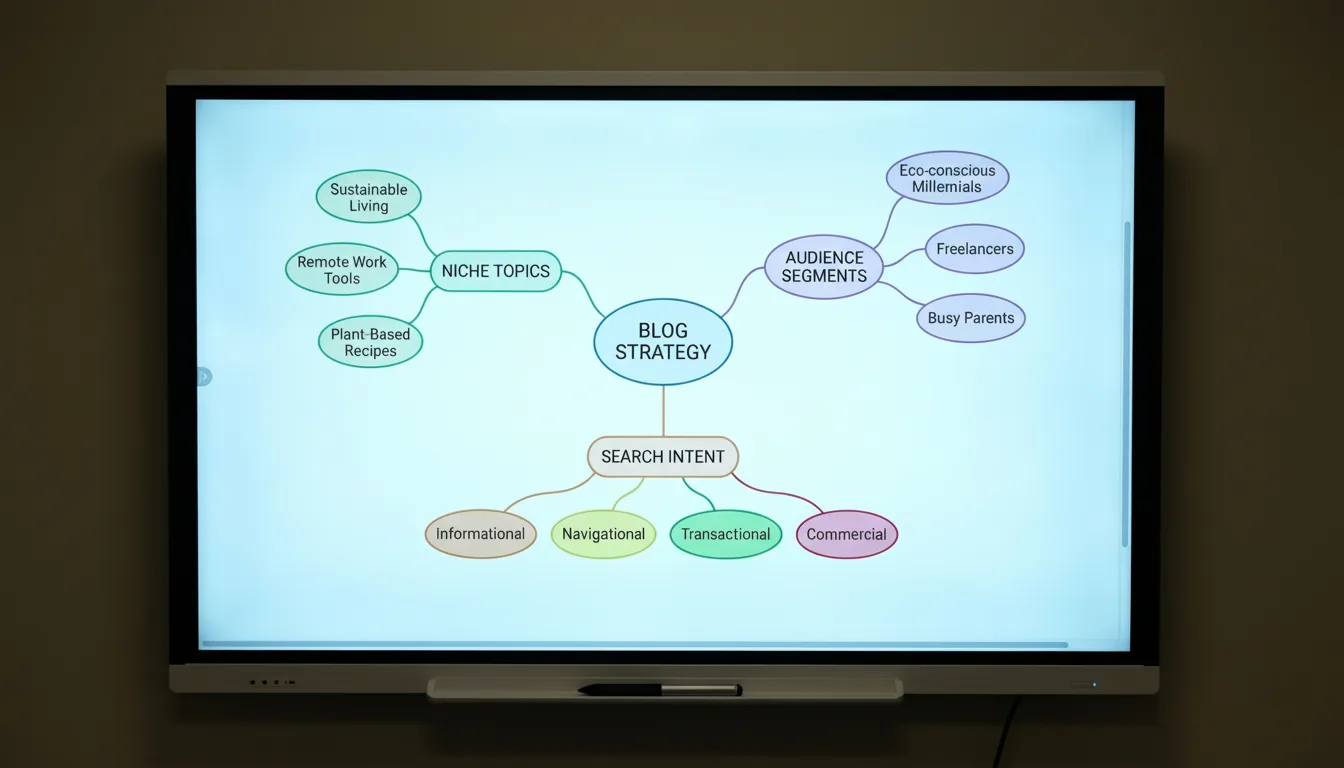
Before touching any tool, a strong ai seo workflow for beginners 2026 starts with clarity about who you want to serve and what problems you want to solve. AI can’t decide your niche or mission, so you need to define your core topics, audience level (beginner, intermediate, pro), and content style (tutorials, reviews, comparisons, news). This also helps AI tools return more relevant keyword suggestions and content ideas because you feed them cleaner, more focused prompts. For example, instead of asking a generic AI SEO tool for “SEO keywords,” you might ask for keywords around “beginner-friendly AI SEO tutorials for small business owners.”
Understanding search intent is equally important because Google and AI engines prioritize pages that clearly match what users actually want to achieve. Common intent types include informational (learn something), transactional (buy something), navigational (go to a known site), and commercial investigation (compare options). A simple ai seo workflow for beginners 2026 should always start by mapping each content idea to one of these intents so your titles, headings, and structure align with user expectations. For example, a guide on how to use ai for keyword research is clearly informational, so it should be structured as a step-by-step guide, not a product landing page.
Once you know your niche and intent, you can group your ideas into topic clusters—collections of related posts that build authority around a theme. AI-powered topical map tools can speed this up by suggesting hub pages, supporting articles, and internal link structures based on existing SERPs. This supports both traditional SEO and AI search visibility because engines can see a clear network of connected articles covering a subject in depth. For beginners, simply deciding on 3–5 core clusters and planning 5–10 posts around each provides more long-term impact than randomly chasing trending topics.
Step 2: How to Use AI for Keyword Research (Beginner-Friendly)
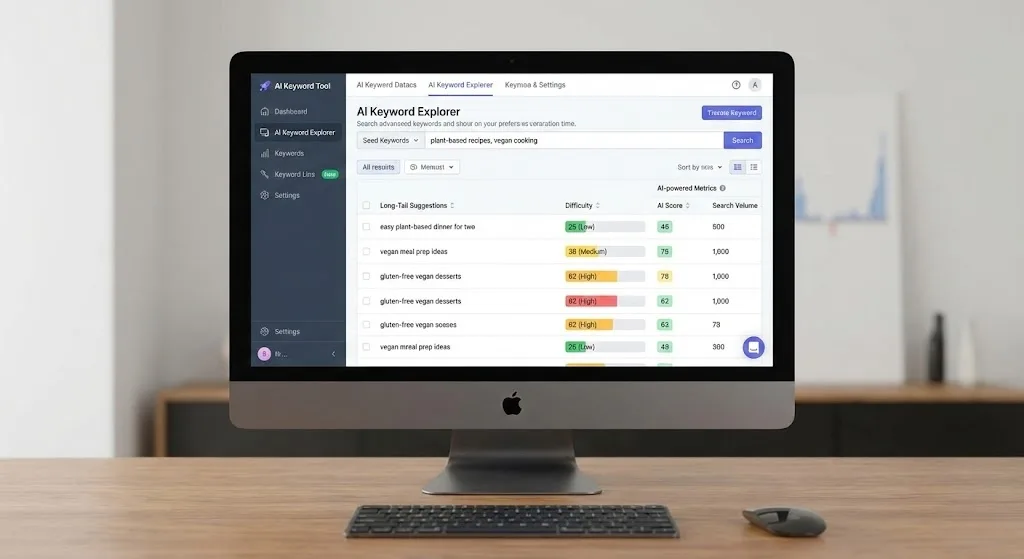
Modern AI tools have made keyword research dramatically faster by combining traditional keyword databases with machine learning models that detect patterns and trends. When learning how to use ai for keyword research, the first step is to choose tools that integrate both search volume and intent analysis—examples include AI-enhanced modules in popular suites or dedicated AI keyword assistants. These systems analyze massive datasets, cluster related terms, and surface long-tail phrases that would be hard to find manually, especially in competitive niches. For an ai seo workflow for beginners 2026, this turns hours of manual spreadsheet work into a 10–15 minute research block per article.
A practical approach is to start with 5–10 “seed keywords” that represent your main topics, such as “AI SEO for bloggers” or “AI tools for content planning.” You feed these into your AI keyword tool, then use filters to highlight low-to-medium difficulty terms with realistic search volume. Good tools also categorize phrases by intent and sometimes even by funnel stage, helping you prioritize educational guides, comparison posts, or conversion-focused pages. This is where the long-tail phrase simple ai seo workflow for beginners 2026 fits nicely—it signals a very clear user intention and lower competition compared with broad, short keywords.
Beyond sheer discovery, AI can help analyze competition by comparing your current content with top-ranking pages to identify gaps and opportunities. Many AI SEO platforms show which keywords competitors rank for, how they structure their headings, and where you can offer deeper or more updated information. Some tools even forecast which keywords are likely to grow, using predictive analytics built from trends and historical data. For beginners, using these insights to create a simple keyword prioritization sheet—focusing on long-tail queries like how to use ai for keyword research—is far more manageable than chasing every high-volume term.
Step 3: Build AI-Assisted Content Outlines and On-Page SEO
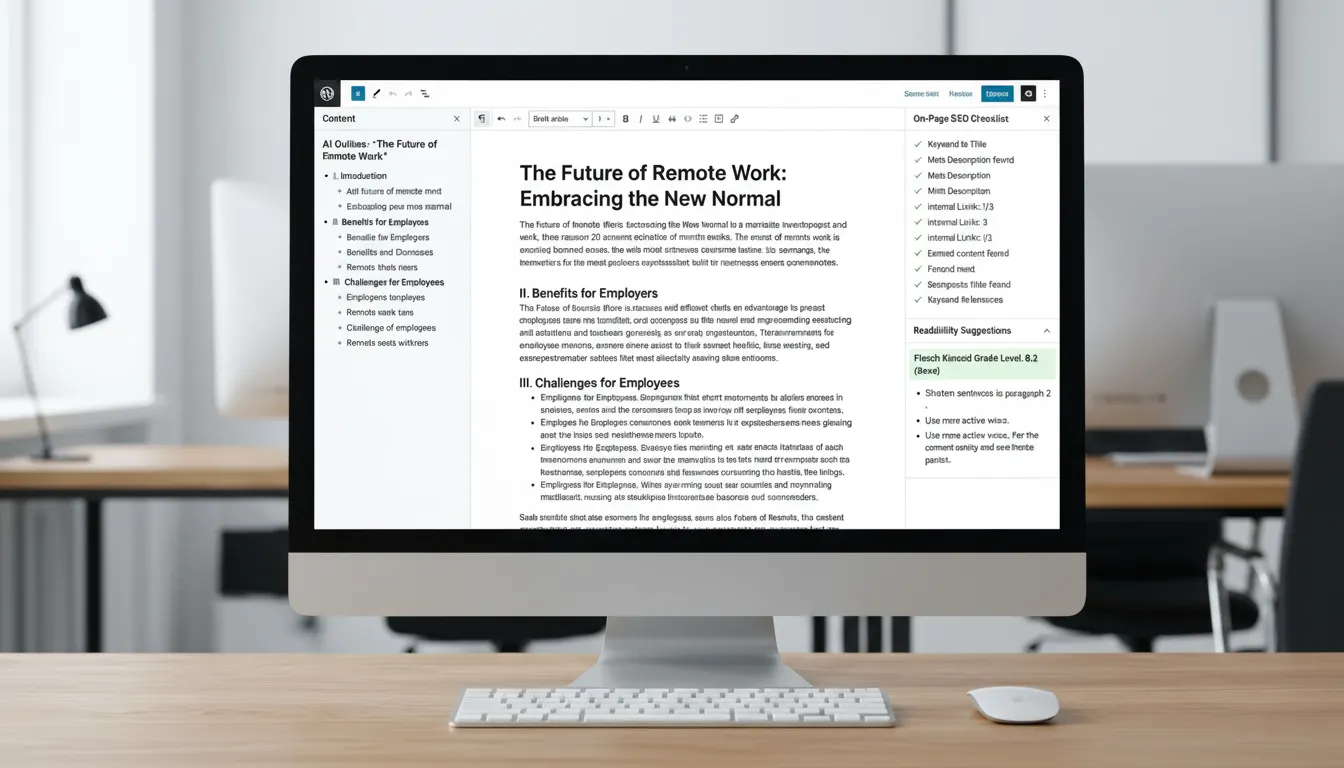
Once you’ve chosen your keywords, the next step in an ai seo workflow for beginners 2026 is using AI to draft smart content outlines instead of full articles. Outline-first workflows allow you to integrate headings, questions, and examples that mirror real search intent while leaving space for your unique expertise. Many AI SEO editors can generate suggested H2s and H3s based on competitors, SERP features, and People Also Ask data, helping you cover the topic comprehensively without copying anyone. For beginners, this is often the fastest way to build a structure that both humans and AI search agents understand.
A good outline usually starts with a clear introduction that references the main keyword once or twice, followed by sections that answer core questions, explain steps, and address objections. AI helps by suggesting subtopics you might miss, such as tools, pitfalls, or future trends related to how to use ai for keyword research or AI SEO workflows. You can then refine these suggestions, remove repetitive ideas, and reorder them to match your audience’s learning journey. When you later draft the content, you can ask AI for paragraph-level assistance—always editing heavily to maintain an authentic, human tone.
On-page SEO in 2026 goes beyond just placing keywords in titles and meta descriptions; it also involves formatting content to help AI models parse and reuse your information. This means using proper heading hierarchies, bullet lists, tables, and schema markup when relevant to make relationships between ideas explicit. AI SEO tools can scan your drafts and suggest improvements: better headings, missing FAQs, additional internal links, and opportunities to include long-tail variations like simple ai seo workflow for beginners 2026 naturally. For a beginner, following these AI suggestions, then reviewing them manually, is one of the fastest ways to grow both skills and rankings.

Step 4: Automate Repetitive SEO Tasks While Staying Human-Centric
A major advantage of an ai seo workflow for beginners 2026 is automation of boring, repetitive tasks like audits, internal linking suggestions, and performance monitoring. AI tools can run site-wide scans to find broken links, missing meta tags, slow pages, and thin content much faster than manual checks. They can also generate prioritized task lists sorted by impact, helping beginners see what to fix first instead of feeling overwhelmed by technical jargon. This frees more time to focus on human elements—like personal stories, case studies, and original visuals—which AI still struggles to replicate authentically.
Automation is particularly effective in technical and off-page SEO. AI-powered crawlers can flag Core Web Vitals issues, indexing problems, and structured data errors, often recommending specific configuration changes. Some systems can even propose internal link placement based on topic clusters and user behavior data, ensuring that key posts like tutorials on how to use ai for keyword research receive enough internal authority. For link building, AI can help identify potential outreach targets, categorize them, and draft outreach templates, although actual relationship-building still benefits from human judgment.
However, relying too heavily on automation can lead to generic content, over-optimized pages, or strategies that ignore brand identity. Human-centric SEO means you always review AI suggestions with your audience in mind, even when following a simple ai seo workflow for beginners 2026. Ask whether each optimization actually improves clarity, trust, or usefulness, rather than blindly chasing scores or checklists. Over time, you will build intuition about which AI recommendations to accept, adapt, or reject, turning you into a strategist, not just a tool operator.
Step 5: Measure, Learn, and Refine Your AI SEO Workflow
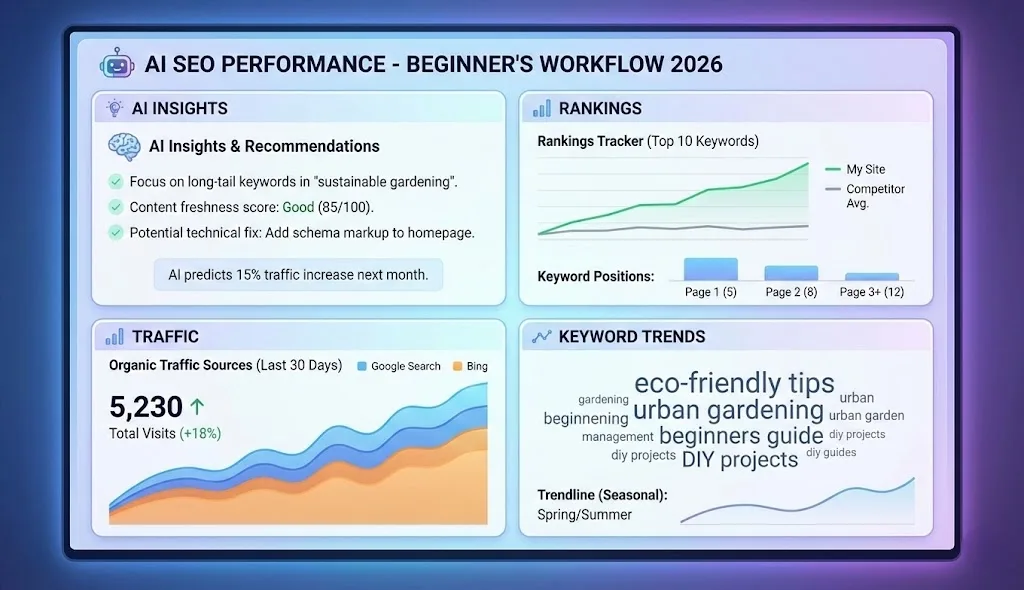
The final stage of an ai seo workflow for beginners 2026 is measurement and refinement, where AI helps you understand what’s working and what needs adjustment. AI-enhanced analytics platforms can combine data from Google Search Console, analytics tools, and rank trackers to show which keywords, pages, and clusters drive the most impressions and clicks. Some systems even highlight AI search appearances, showing when your pages are cited or summarized in AI overviews or answer boxes. For beginners, this turns complex data into simple narratives and actionable next steps.
Effective learning loops start with tracking a focused set of metrics: organic traffic, clicks from your main keywords, time on page, and conversion actions like sign-ups or downloads. AI can detect patterns, such as which article formats perform best or which clusters attract returning visitors. When a guide about how to use ai for keyword research outperforms others, you can ask your AI tools to analyze differences in structure, depth, or intent alignment. You then apply those insights to future posts, slowly refining your simple ai seo workflow for beginners 2026 into a more advanced, personalized system.
Continuous improvement also involves revisiting older content and updating it using fresh AI insights. AI content auditors can flag outdated statistics, missing sections, or new questions users are asking in your niche. Instead of rewriting everything from scratch, you add new paragraphs, FAQs, internal links, and multimedia to keep posts relevant for both search engines and AI answer engines. This cyclical approach makes your SEO strategy more resilient to algorithm updates because you are always closing gaps and reinforcing your authority.

Final Thoughts and Conclusion
IIn 2026, the most effective SEO strategies are built around collaboration between human creativity and AI-powered analysis, not one replacing the other. Search is shifting toward AI overviews, conversational answers, and intent-rich queries, so brands that combine real human insight with smart automation consistently outperform those relying on either side alone.
A well-structured ai seo workflow for beginners 2026 makes this partnership practical: AI tools handle discovery, clustering, outlining, auditing, and tracking, while you shape the narrative, tone, and unique perspectives that readers and AI engines value. Instead of seeing AI as a shortcut for mass content, you treat it as a strategic co-pilot that amplifies your research and planning while you remain responsible for story, nuance, and trust. When you consistently apply a simple ai seo workflow for beginners 2026, every new post builds more topical depth, authority, and long-term organic visibility, because each article intentionally connects to your broader content map and audience journey.
Focusing on how to use ai for keyword research is one of the highest-leverage moves you can make as a beginner because it directly influences what you write, how you structure it, and which search intents you target. Instead of guessing topics or copying competitors, you use AI to uncover the real language your audience uses, long-tail questions they actually ask, and gaps that aren’t well covered yet.
With AI surfacing long-tail opportunities and clustering related questions, you can plan content that is realistically able to rank, even against bigger brands with more backlinks and higher domain authority. This approach turns your content calendar into a deliberate strategy: each article tackles a focused problem, uses clear intent-aligned formatting, and feeds both search engines and AI answer systems with structured, trustworthy information. Add human-centric storytelling, real experiences, screenshots, and clear calls-to-action, and you transform AI-assisted posts into memorable resources rather than generic articles that readers forget after one skim.
Over time, your AI SEO routine becomes less about chasing hacks, loopholes, or one-off algorithm tricks and more about refining a sustainable, repeatable system that grows with your brand. You start to see patterns in what works: which content formats get saved and shared, which comparison posts convert, and which guides on how to use ai for keyword research bring in the most qualified readers.
AI analytics can highlight these insights faster, but it is your judgment that decides which directions to double down on and which experiments to drop. As AI search continues to evolve, sites that prioritize honest value, clear explanations, and consistent optimization will remain strong, regardless of interface changes, new SERP layouts, or shifts in how AI overviews are displayed. By committing to a human-led, AI-supported ai seo workflow for beginners 2026, you build a resilient foundation where each article not only ranks but also strengthens your reputation, earns trust, and keeps readers coming back for more. To stay ahead of upcoming AI SEO trends, practical tool breakdowns, and real-world workflows that actually work, follow Ai Tech Unboxed for more.
FAQs on AI SEO Workflow and AI Keyword Research (2026)
1. Is AI SEO safe for beginners, or can it hurt rankings?
AI SEO is safe for beginners when used as an assistant rather than an auto-publishing engine. Problems arise when entire articles are generated and published without editing, fact-checking, or alignment with user intent. A structured ai seo workflow for beginners 2026 that keeps humans in control of final content avoids these risks.
2. How often should I use AI tools for keyword research?
For most small or growing sites, running AI-based keyword research once per month and before each major article is enough. This cadence lets you capture new trends, long-tail queries, and seasonality without constantly chasing minor shifts. Aligning these research sessions with your editorial calendar ensures how to use ai for keyword research becomes a repeatable habit, not a one-off task.
3. Can a simple AI SEO workflow really compete with big brands?
Yes, especially when you focus on long-tail topics, clear intent, and high-quality answers. Big brands often miss niche questions, personal-use cases, or emerging tools that smaller sites can cover in depth. A simple ai seo workflow for beginners 2026 that prioritizes clarity, topical clusters, and consistent updates can carve out strong positions in these gaps.
4. Which metrics matter most when tracking an AI SEO strategy?
Key metrics include organic clicks, impressions for target keywords, average position, and engagement signals like time on page and bounce rate. AI analytics can combine these into simple dashboards that highlight your best-performing topics and weak spots. Over time, tie these metrics back to stages of your ai seo workflow for beginners 2026 so you can see which steps drive the biggest improvements.
5. How do I keep AI-assisted content human and original?
Always treat AI as a draft generator or idea partner, not a substitute for your perspective. Add your own experiences, examples, screenshots, and opinions to every post, especially on how you actually use tools or workflows. This approach keeps guides on topics like how to use ai for keyword research fresh, authentic, and aligned with your brand voice.