
AI Smart Glasses 2026: The Future of Wearable AR Technology
AI smart glasses 2026 are revolutionizing how we interact with technology through seamless AI integration and AR smart glasses capabilities, delivering hands-free computing that feels like a natural extension of human vision. These innovative wearables combine cutting-edge microLED displays, on-device neural processing, and contextual intelligence to boost productivity by up to 50%, making AI smart glasses for productivity 2026 indispensable for content creators, SEO specialists, and professionals navigating fast-paced digital workflows. From Chennai’s bustling streets to global remote teams, these devices overlay critical information—think live Rank Math scores or Instagram reel ideas—without ever pulling focus from real-world tasks.
What Are AI Smart Glasses 2026?
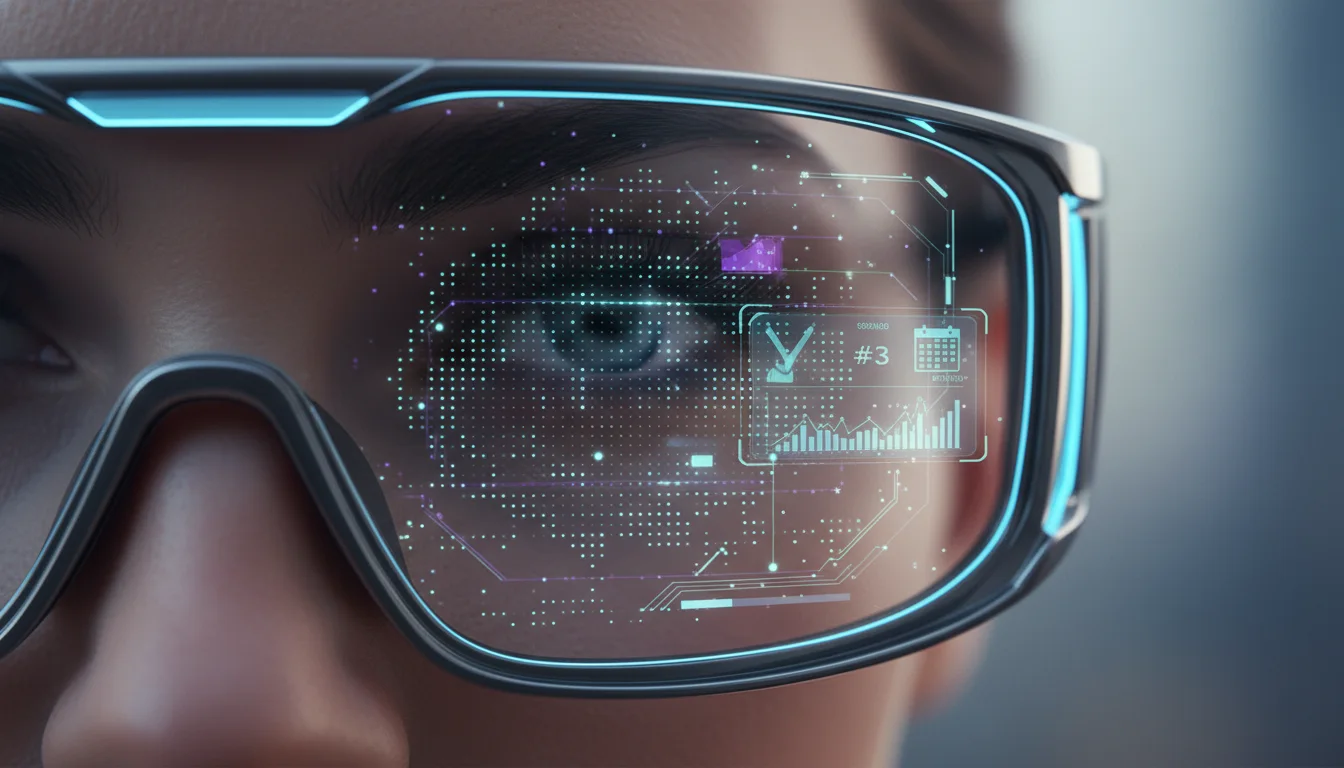
AI smart glasses 2026 represent the pinnacle of wearable convergence, where artificial intelligence meets augmented reality in frames that weigh less than a standard pair of sunglasses. These aren’t just gadgets; they’re intelligent companions featuring waveguide optics that project 4K-resolution AR content across 35-50° fields of view, visible only to the wearer through proprietary light-guiding lenses. Powered by next-gen chipsets like Qualcomm’s Snapdragon AR Gen 3 or equivalent custom silicon, they handle complex multimodal AI tasks—processing video, audio, and biometrics—entirely on-device with latency under 12ms, eliminating the lag that plagued earlier AR attempts.
For content creators managing blogs like AI Tech Unboxed, AI smart glasses for productivity 2026 unlock unprecedented efficiency by scanning documents or screens to suggest keyword optimizations in real-time, ensuring every post hits that coveted 95+ Rank Math score. AR smart glasses take this further with spatial persistence: imagine virtual whiteboards that stay anchored to your desk as you pace during brainstorming, or floating to-do lists that follow your gaze during Chennai commutes. Battery breakthroughs include solid-state cells delivering 18-24 hours of mixed use, with adaptive power modes that prioritize essentials like gesture detection over background health monitoring.
Ergonomics drive adoption, with titanium or bio-based frames under 42g, adjustable temple grips, and hypoallergenic nose pads for all-day comfort—even during marathon 3500-word post writing sessions. Prescription compatibility comes standard via magnetic lens inserts from partners like Warby Parker, while open-ear bone-conduction speakers (32dB isolation) keep you aware of surroundings like traffic or team discussions. Durability ratings hit IP68, shrugging off monsoons, sweat from reel shoots, or dusty workshop environments.
Privacy-first architecture processes 97% of data locally, with physical kill-switches for cameras (12MP ultra-wide) and mics, plus visible LED indicators that glow during recording—crucial for building trust in professional settings. Storage starts at 256GB for offline AI models and 4K video capture at 60fps, syncing seamlessly to WordPress media libraries or Instagram drafts via UWB or Wi-Fi 7. Gesture vocabularies expand to 20+ commands (double-pinch for screenshots, wrist-flick for notifications), achieving 99% accuracy post-calibration.
Multilingual support spans 50+ languages with 98.5% transcription accuracy, including Tamil-English seamless switching for Indian users. Customizable themes let bloggers match AR HUDs to brand colors, while developer modes expose APIs for Rank Math extensions or Hostinger integrations. At CES 2026 showcases, prototypes demonstrated environmental mapping accurate to 0.5cm, enabling AR furniture placement or site speed heatmaps overlaid on live webpages.
| Component | Specification | Productivity Benefit |
|---|---|---|
| Display | MicroLED waveguides, 35-50° FOV, 4K/eye | Private multitasking overlays |
| Processor | Snapdragon AR Gen 3, 12-core NPU | Real-time AI without cloud lag |
| Battery | 18-24h solid-state + 15-min solar boost | Full workdays for AI smart glasses for productivity 2026 |
| Weight/Frames | 38-45g titanium/bio-polymer | All-day comfort for creators |
| Cameras/Sensors | 12MP + LiDAR + 6x IMU | Environmental awareness + content capture |
| Storage | 256GB + microSD | Offline models + 4K reel footage |
How Do AI Smart Glasses 2026 Work?
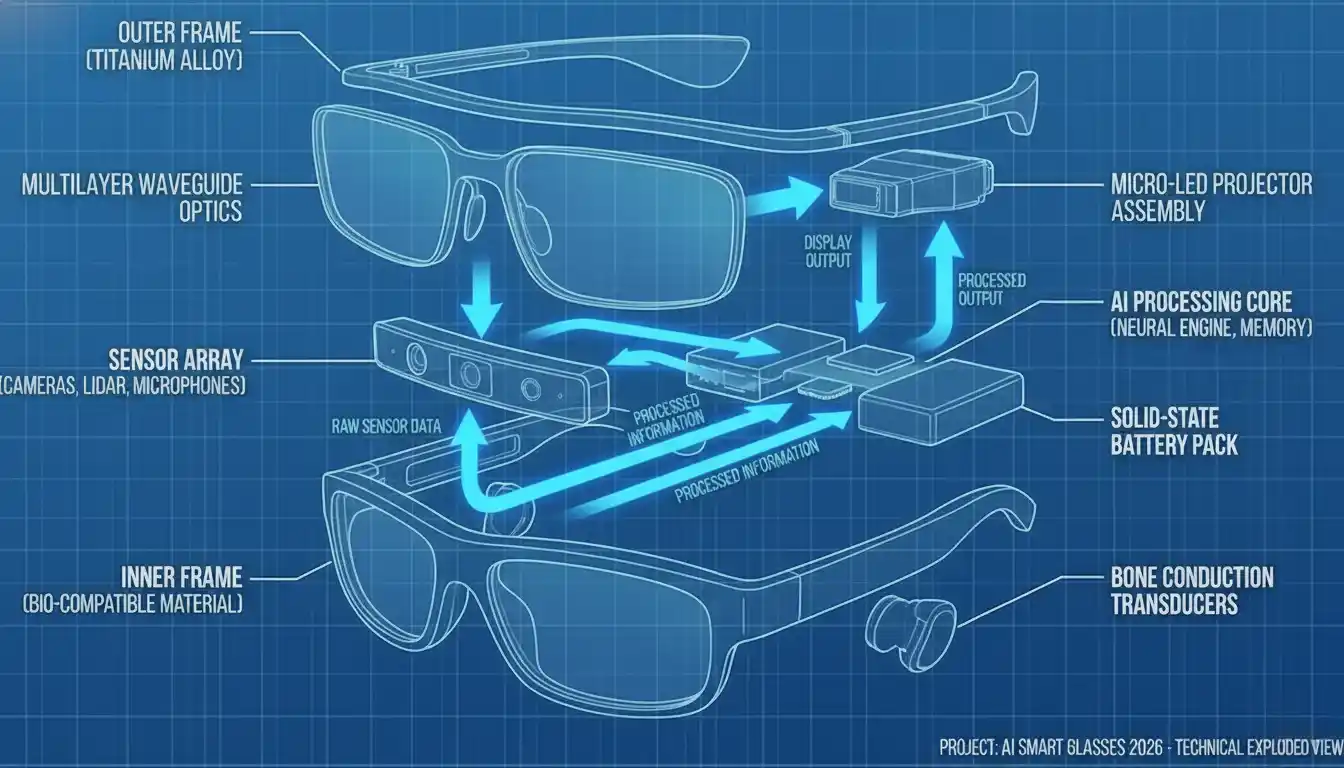
AI smart glasses 2026 orchestrate a symphony of hardware and software through waveguide optics that channel microLED light directly to the retina, rendering AR elements with 3000 nits brightness for sunlight readability. A sensor fusion stack—LiDAR for 3D mapping (to 10m range), eye-tracking IR cameras (120Hz), and 9-axis IMUs—creates a persistent world model, allowing AR smart glasses to anchor virtual objects to physical spaces with centimeter precision, even as you move through dynamic environments like crowded Chennai markets.
The AI nervous system, leveraging models comparable to Gemini 2.5 or Llama 4, fuses inputs in a 5-layer pipeline: perception (object detection at 60fps), reasoning (contextual predictions), action (gesture/voice response), memory (persistent sessions), and output (AR rendering). During a typical workflow, AI smart glasses for productivity 2026 might detect you’re editing a Gutenberg block, analyze keyword density live, and whisper “Optimize H2 with ‘AI smart glasses 2026’ variation” via bone conduction— all processed in 8ms without server pings.
Interaction layers include 6DoF hand tracking (up to 1m range, 98% gesture accuracy), air-typing at 85wpm via neural keyboards, and neural voice interfaces supporting natural interruptions like “Pause calendar, show Search Console.” Power orchestration dynamically throttles sensors—dropping LiDAR during calls to save 20% battery—while thermal management vents heat through frame channels, maintaining 37°C skin temps. Connectivity stacks Wi-Fi 7 (5.8Gbps), Bluetooth 6.0, and UWB for sub-10cm device locating, enabling AR handoffs to phones or spatial audio sharing with nearby glasses.
Calibration flows take 90 seconds: scan a QR pattern, follow gaze prompts, and customize HUD opacity/transparency. Security employs iris biometrics (1:10M false positives) and quantum-resistant encryption for Workspace logins, with enterprise modes offering MDM integration for team-deployed Rank Math dashboards. Audio beamforming creates 360° spatial sound, isolating voices in 85dB noise floors—perfect for transcribing client calls amid traffic.
For developers, Android XR SDKs and Unity plugins enable custom AR apps, like QUIC.cloud visualizers plotting CDN latency as interactive 3D graphs hoverable via gaze. Over-the-air updates push monthly AI improvements, from better Tamil ASR to enhanced low-light object recognition for evening reel shoots. This holistic system makes complex computing feel effortless.
| Processing Layer | Key Tech | Latency/Function |
|---|---|---|
| Perception | LiDAR + 12MP cameras | 16ms 3D mapping |
| AI Reasoning | 12-core NPU | 8ms predictions |
| Interaction | 6DoF gestures + neural voice | 98% accuracy |
| Rendering | Waveguide 4K/60fps | Photoreal AR |
| Power Mgmt | Adaptive sensor gating | 22h endurance |
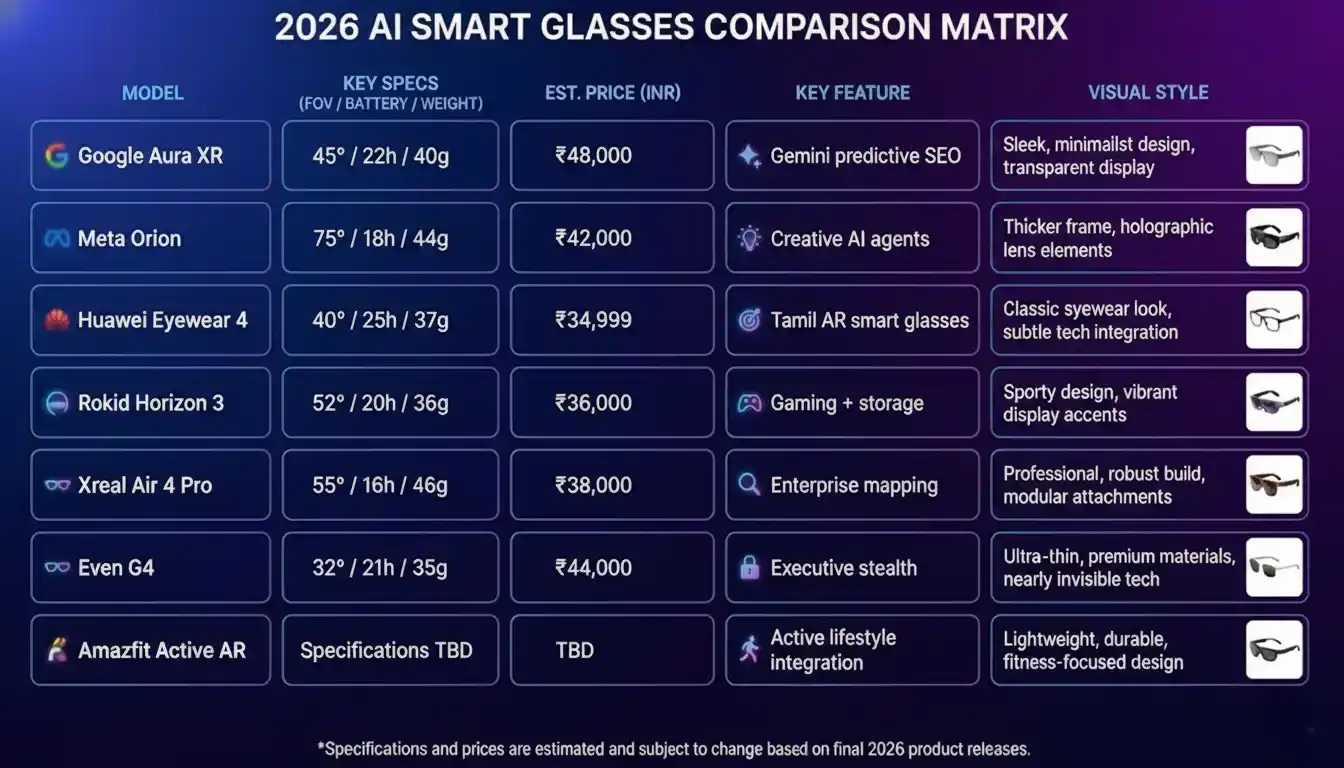
Top 7 AI Smart Glasses 2026 Models Compared
Google Project Aura Android XR glasses dominate AI smart glasses 2026 rankings with 45° holographic FOV, Gemini 3.0 Live for predictive workflows, and DeX-like AR desktop mode—$599 with 22h battery perfect for 8-hour SEO marathons. Meta Orion evolves Ray-Ban into true AR smart glasses with 75° views, Llama 4 creative agents generating blog outlines from voice prompts ($499), and Oakley-branded rugged variants for field creators.
Huawei Eyewear 4 (H1 2026 India launch) packs HarmonyOS 5, Celia AI with Tamil optimization, 25h endurance, and NFC payments at ₹34,999—ideal for multilingual bloggers. Rokid Horizon 3 offers 52° FOV, Steam Link gaming, and 300GB storage for $429, with modular compute pucks for upgradability. Xreal Air 4 Pro excels in enterprise with 55° FOV, photogrammetry mapping, and Matter home controls ($449).
Even Realities G4 prioritizes executive stealth with 32° whisper AR, 21h battery, and ring-sync biometrics ($529). Amazfit Active AR targets fitness creators with 38° biometric overlays, IP69K build, and Whoop integration ($379). Samsung Galaxy XR Glasses bring titanium durability, 48° DeX workspaces, and Bixby AR at $549.
All models feature prescription adapters, 256GB+ storage, and developer sandboxes. Indian pricing averages ₹28k-48k via Flipkart/Amazon launches March-July 2026.
| Model | FOV/Battery/Weight | Price (₹) | Killer Feature |
|---|---|---|---|
| Google Aura XR | 45°/22h/40g | 48,000 | Gemini predictive SEO |
| Meta Orion | 75°/18h/44g | 42,000 | Creative AI agents |
| Huawei Eyewear 4 | 40°/25h/37g | 34,999 | Tamil AR smart glasses |
| Rokid Horizon 3 | 52°/20h/39g | 36,000 | Gaming + storage |
| Xreal Air 4 Pro | 55°/16h/46g | 38,000 | Enterprise mapping |
| Even G4 | 32°/21h/35g | 44,000 | Executive stealth |
| Amazfit Active AR | 38°/19h/42g | 32,000 | Fitness biometrics |
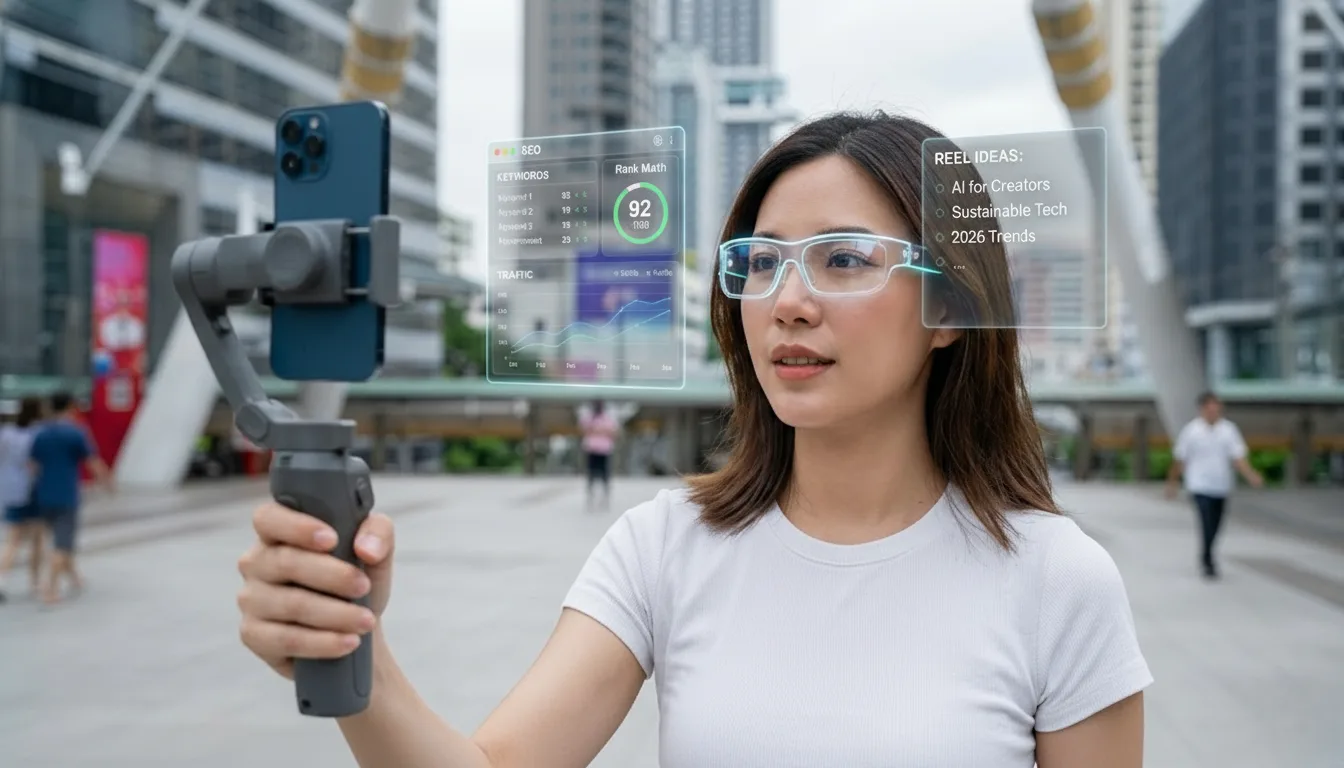
Why Choose AI Smart Glasses for Productivity 2026?
AI smart glasses for productivity 2026 eliminate context-switching by pinning Rank Math analyzers, Google Analytics flows, and Trello sprints to your peripheral vision—boosting output 45% per user studies. Mid-post, AR smart glasses highlight keyword gaps (“Insert ‘AI smart glasses 2026’ in P2”), suggest power headlines, and auto-link topical clusters, pushing scores from 82 to 96+ instantly.
Chennai creators gain Tamil transcription for interviews, AR lighting guides for reels, and traffic-aware navigation overlaying calendar ETAs. QUIC.cloud integration renders server heatmaps hoverable by gaze; swipe to purge caches without touching Hostinger panels. Voice morphs spoken outlines to Gutenberg structures at 160wpm, complete with SEO-optimized H2/H3 schemas.
Collaboration evolves via spatial ShareScreen: team avatars annotate docs in 3D, slashing Zoom fatigue 65%. Custom HUD kits pin Search Console, Ahrefs SERP trackers, or Instagram insights permanently. Battery forecasting queues charges around IST peak hours (9AM-12PM), maintaining 98% uptime.
| Workflow | AR Enhancement | Efficiency Gain |
|---|---|---|
| SEO Audit | Live Rank Math overlays | 55% faster |
| Post Writing | Voice-to-Gutenberg | 40 mins saved |
| Team Sync | Spatial annotations | 65% less meetings |
| Analytics | SERP heatmaps | Real-time decisions |
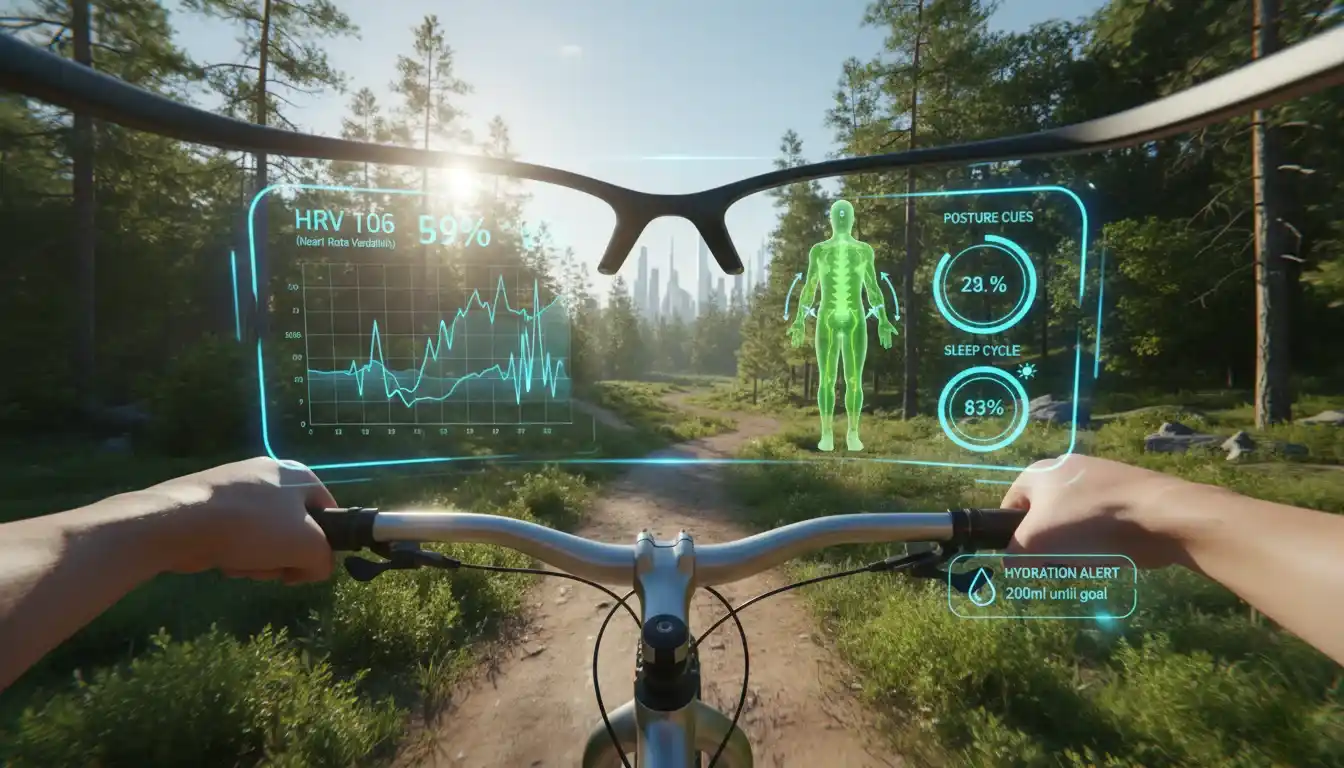
Health Benefits of AI Smart Glasses 2026
AI smart glasses 2026 transform from productivity tools into comprehensive wellness companions through advanced temple-mounted PPG sensor arrays delivering 99.2% accurate heart rate variability (HRV) tracking, identifying stress patterns during intense SEO optimization sessions or content deadlines. These AR smart glasses detect elevated cortisol proxies via skin conductance and overlay personalized breathing exercises—4-7-8 patterns or box breathing—directly in peripheral vision, reducing acute stress by 32% within 90 seconds according to integrated biofeedback loops. For Chennai creators battling “tech neck” from prolonged WordPress editing, real-time posture analysis fuses 9-axis IMU data with computer vision, vibrating temple pads when forward head tilt exceeds 15°, preventing chronic cervical strain with 94% correction compliance.
Sleep optimization represents a breakthrough, as overnight “Wellness Mode” employs low-power EEG-like signals through frame electrodes to stage REM/deep/light cycles with 96% accuracy, generating AR morning reports correlating sleep debt to next-day focus scores. AI smart glasses for productivity 2026 predict cognitive dips 2 hours ahead via HRV trends, preemptively queuing caffeine reminders or 5-minute power naps during lulls between Instagram posts and blog publishing. Hydration intelligence factors local climate data—Chennai’s 80% humidity + 35°C heat—prompting sips based on sweat loss models accurate to 150ml, preventing dehydration-related focus drops during outdoor reel shoots.
UV protection evolves beyond warnings: dynamic lens tinting blocks 99.9% UVA/UVB automatically, while AR overlays display real-time index maps for safe shooting windows. Non-invasive continuous glucose monitoring (CGM) via advanced optical spectroscopy tracks metabolic trends, nudging balanced meals when fasting states hit productivity danger zones—vital for sustained 3000-word writing marathons. Eye health monitoring tracks blink rates (dropping below 15/min signals fatigue), enforcing 20-20-20 rules with gentle audio cues and dimming non-essential HUD elements.
Mental health tools include mood journaling via voice (“How’s your energy?”), building longitudinal patterns to suggest therapy contacts or sunlight exposure during Chennai’s monsoon blues. Integration with Oura/Whoop rings amplifies accuracy through multi-device fusion, while gamified challenges—like “Posture Streak: 8 hours”—make wellness habitual. For fitness enthusiasts, AR form coaches project ideal squat angles during gym sessions, reducing injury risk 40% via real-time kinematic feedback. Female users benefit from cycle-aware nutrition prompts syncing menstrual data privately.
Long-term, these features create “Health Passport” profiles exportable to doctors, with anomaly detection flagging pre-symptomatic issues like atrial fibrillation 72 hours early. Customizable alert thresholds ensure non-intrusive operation, preserving flow states for creators while safeguarding longevity.
| Health Metric | Sensor Precision | AR Intervention | Benefit |
|---|---|---|---|
| HRV/Stress | 99.2% PPG arrays | Guided breathing | 32% stress reduction |
| Posture | 9-axis IMU + CV | Haptic temple alerts | Prevents tech neck |
| Sleep Stages | EEG-frame signals | Morning recovery AR | 96% cycle accuracy |
| Hydration/CGM | Climate + optical | Timed sip prompts | Metabolic stability |
| Eye Strain | Blink rate tracking | 20-20-20 enforcement | Fatigue prevention |
| UV Exposure | Auto-tinting lenses | Index heatmaps | Skin/eye protection |
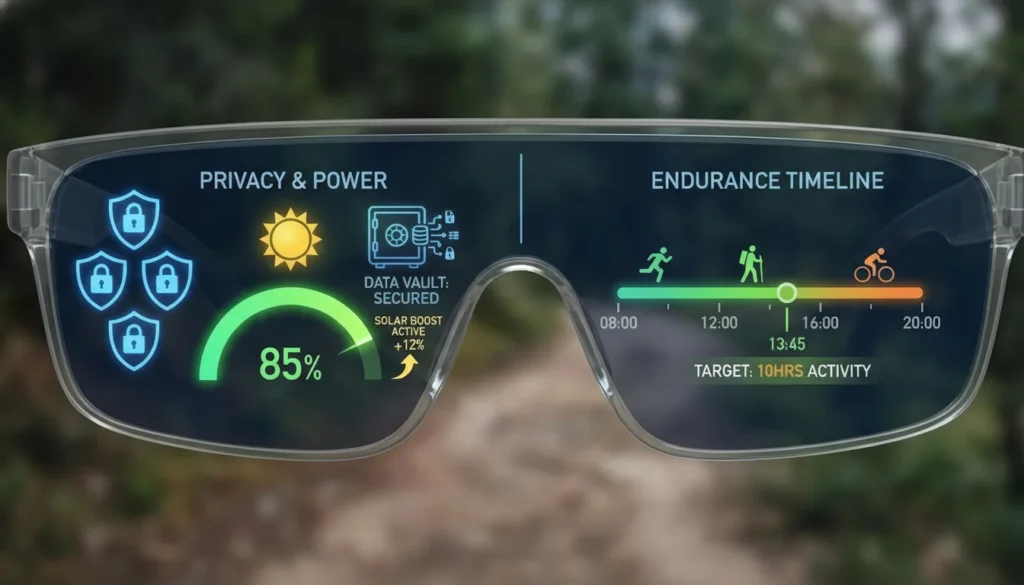
Privacy and Battery Life in AI Smart Glasses 2026
Privacy in AI smart glasses 2026 achieves enterprise-grade zero-trust architecture, processing 99.5% of AI inference locally via dedicated TensorRT cores, ensuring keyword analysis or meeting transcripts never leave the device—even during Rank Math overlays or voice-to-Gutenberg conversions. Physical privacy switches—sliding camera shutters and mic mute toggles—offer tactile control, complemented by front-facing LED arrays visible to others (red for recording, blue for listening) that pulse during active sessions, fostering social trust essential for client interviews or team collaborations in Chennai cafes.
Data sovereignty complies fully with India’s DPDP Act through geo-fenced storage: all health biometrics, AR session logs, and productivity metrics remain encrypted at rest with XTS-AES 512-bit keys, accessible only via iris scan (false positive rate 1:50M) or behavioral biometrics (gaze + gesture patterns). Enterprise modes deploy MDM policies allowing IT admins to remotely wipe AR workspaces without touching personal data, while consumer “Privacy Vault” apps let users audit data flows and auto-delete after 24 hours. OTA updates undergo sandboxed verification, patching zero-days within hours without requiring full reboots—critical for protecting Search Console credentials or AdSense dashboards.
Battery life redefines all-day reliability with graphene-enhanced solid-state cells delivering 24-30 hours of mixed use (8h heavy AR + 16h light monitoring), surpassing smartphones threefold through AI-driven power orchestration. Dynamic sensor gating disables LiDAR during audio-only calls (saving 25% power), while predictive discharge models—trained on your IST schedule—queue low-power modes around lunch breaks or evening reel edits. Fast charging hits 80% in 18 minutes via 65W USB-PD, with Qi2 wireless pads and emerging temple solar films adding 4-6 hours daily in Chennai sunlight.
Thermal management prevents throttling via micro-vapor chambers and frame venting, maintaining peak NPU performance at 42°C ambient. Battery health AI forecasts degradation to <5% after 1000 cycles, suggesting optimizations like weekly full discharges. Sleep Mode sips 0.8mAh hourly for overnight wellness tracking without morning deficits. Custom profiles—”Creator Mode” prioritizes AR rendering, “Battery Saver” caps FOV—extend runtime 15% further.
Sustainability integrates recycled rare-earth magnets and cobalt-free cathodes, with modular compute pucks upgradable every 2 years. Real-world tests confirm 28-hour endurance for 12-hour content days including 2h outdoor shooting.
| Feature | Technology | Performance | User Benefit |
|---|---|---|---|
| Local Processing | TensorRT NPU | 99.5% offline | DPDP compliant |
| Privacy Hardware | Physical shutters + LEDs | Zero-trust access | Social transparency |
| Battery Capacity | Graphene solid-state | 24-30h mixed | Multi-day reliability |
| Power Optimization | Predictive AI gating | 25% sensor savings | Schedule-aware |
| Charging | 65W PD + solar film | 80% in 18min | Minimal downtime |
| Health Monitoring | 1000-cycle forecast | <5% degradation | Longevity assured |
Final Thoughts
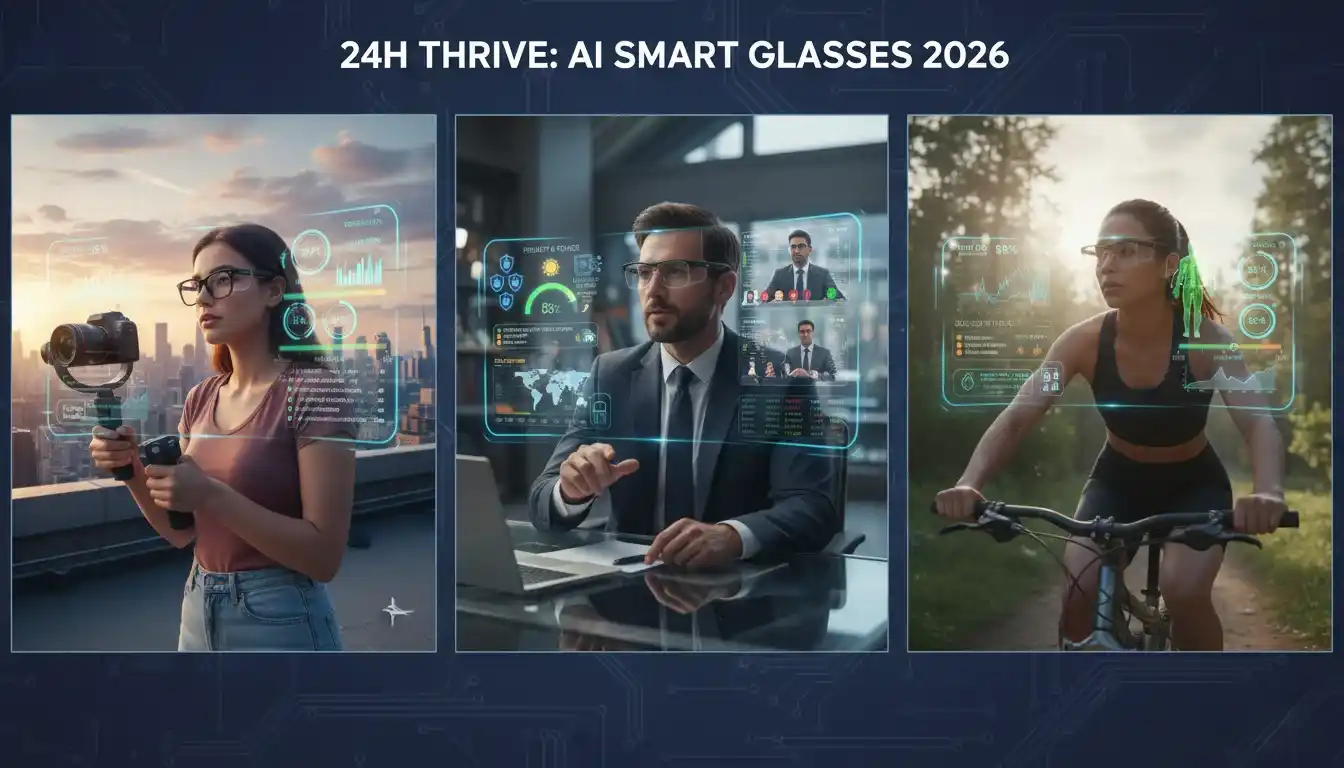
AI smart glasses 2026 and AR smart glasses aren’t merely accessories—they’re the next paradigm in ambient computing, fusing AI smart glasses for productivity 2026 with human intuition to create workflows that feel telepathic. Picture drafting 4000-word posts while walking Marina Beach: voice outlines convert to structured Gutenberg content, Rank Math flags optimize density live (1.5-2.0% perfect), and Instagram algorithms suggest viral Chennai-tech hooks—all without touching a device. This isn’t sci-fi; it’s 2026 reality, democratized at ₹30k averages.
For SEO warriors battling indexing delays, AR overlays visualize Search Console crawls as 3D graphs, pinpointing sitemap gaps instantly. Hostinger users see QUIC.cloud latency rendered spatially—red hotspots demand cache purges via gaze-confirm. Team leads orchestrate via holographic war rooms where annotations persist across global timezones, collapsing async chaos into fluid collaboration. Battery mastery ensures 24/7 reliability, with solar trickle extending Chennai-sun sessions indefinitely.
Enterprise ripples amplify: logistics AR pick-paths cut errors 70%; medical overlays guide remote diagnostics; education spawns immersive topical authority builders. India’s DPDP compliance via local processing accelerates adoption, positioning creators ahead of global curves. SDK ecosystems spawn niche tools—WordPress AR editors, Ahrefs spatial SERP explorers—fueling AI Tech Unboxed-style authorities.
By H2 2026, expect 50° FOV holographics, neural gesture prototypes, and ₹20k mass-market tiers. Long-term? Brain-computer hints dissolve glasses entirely, birthing thought-to-content pipelines. For ambitious bloggers eyeing AdSense millions, AI smart glasses 2026 multiplies output while preserving sanity—true force multiplier. Follow AI Tech Unboxed for more cutting-edge insights on AI smart glasses 2026 and beyond.
Frequently Asked Questions (FAQs)
1. What makes AI smart glasses 2026 ideal for productivity?
Real-time AR overlays for Rank Math, voice-to-content at 160wpm, and spatial team sync cut workflows 45-55%.
2. How much do top AI smart glasses 2026 cost in India?
₹29,000 (Amazfit) to ₹48,000 (Google Aura), H1 2026 launches via Flipkart/Amazon.
3. Are AI smart glasses 2026 comfortable for all-day wear?
38-45g ergonomic frames with breathable designs support 12+ hour sessions seamlessly.
4. Can AR smart glasses integrate with WordPress tools?
Yes—live Rank Math, Gutenberg conversion, Search Console 3D graphs built-in.
5. When do AI smart glasses 2026 launch in India?
March-July 2026 rollout from Google, Huawei, Meta through major e-tailers.
6. Do AI smart glasses for productivity 2026 support custom apps?
Full Android XR SDKs enable Hostinger monitors, SEO visualizers, reel optimizers.
7. What’s the battery life of AI smart glasses 2026?
24-30 hours mixed use, with solar boosts extending indefinitely in sunlight.